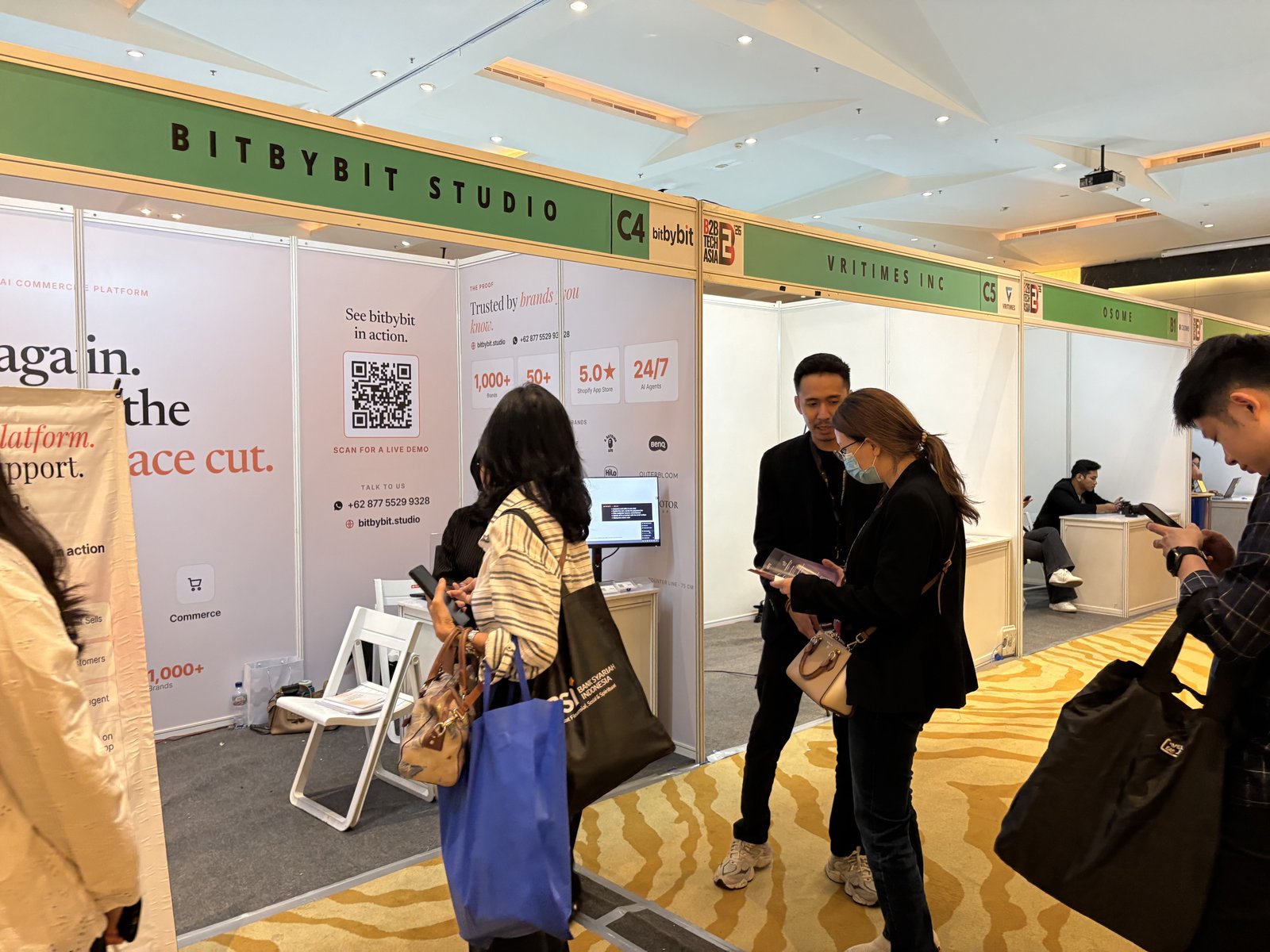
bitbybit Studio was invited as an exhibitor at B2B Tech Asia 2026, where the team ran a live showcase of conversational commerce over two days and more than 100 conversations with brands across retail, F&B, e-commerce, and enterprise.
The demo itself was simple to describe and, based on the reaction it got, harder for most brands to picture until they saw it: one AI agent, handling a conversation from first contact through repeat purchase, inside a single WhatsApp thread, against one customer record. Product questions, order status, a reorder — same conversation, same context, no channel switch, no re-authentication, no starting over with a different tool.
What that showcase surfaced, conversation after conversation, was less about the technology and more about a gap most brands hadn’t articulated out loud: they’d paid to acquire a customer once, and were paying again — in marketplace margin — every time that same customer came back through a platform they didn’t own.
What we showcased
The core of the showcase was conversational commerce running end to end inside WhatsApp: a single AI agent fielding pre-sale questions, checking order status, and closing a repeat purchase, all without the customer or the brand leaving the thread. Behind that one conversation sat a persistent customer record — order history, conversation history, and context carried forward automatically rather than reconstructed by whichever tool happened to answer next.
For most brands walking the floor, this was the first time they’d seen an AI agent connected to live commerce context rather than operating as a standalone support queue. That distinction — an agent with access to a real customer record versus an agent answering from a script — was the single biggest driver of the “wait, so my repeat customers don’t have to go back to the marketplace at all?” reaction that came up repeatedly across the two days.
bitChat is what powers the agent surface in WhatsApp; bitCRM is what holds the customer record the agent acts on. The showcase ran both together so the connection between the two was visible in real time, not explained in a slide.
The objection behind the interest
According to Hanna Dela, Partnership Manager at bitbybit Studio, who led the booth for the full two days, the single most common objection raised before people even saw the demo was some version of the same fear: that they’d lose ownership of their own customer data, and pay the marketplace margin again on the same customer regardless.
“The same objection came up more than a hundred times in two days: ‘if I move to WhatsApp, do I lose visibility into my own customers?’ It’s the opposite. What surprised people is that they finally own that conversation history instead of renting access to it every time a customer comes back.” — Hanna Dela, Partnerships, bitbybit Studio
The degree of concern tracked with company size. Enterprise conversations at the booth centred specifically on data ownership and margin structure — questions about who controls the customer record and where the take rate actually lands — more than the tactical, day-to-day retention questions retail and F&B brands tended to lead with. One brand put the trigger plainly: they were actively looking for an alternative because marketplace margins had recently climbed to a level they considered unsustainable for their category.
Why the demo changed the conversation
Once brands saw the AI agent operating against a real customer record instead of a scripted flow, the objection about “losing visibility” tended to flip. The problem they’d been describing — paying a marketplace’s take rate on every repeat transaction, indefinitely — turned out to be the same problem the demo solved by design: an owned conversational channel where the brand, not a rented platform, holds the customer relationship.
Somewhere between 10% and 25% of a repeat transaction typically goes to the platform it runs through, depending on category and marketplace. Most brands know their customer acquisition cost and know their repeat purchase rate, but few had connected the two into a single number — how much margin gets surrendered, indefinitely, on customers they’d already won. Seeing an AI agent handle that same repeat purchase inside a channel the brand owns made the alternative concrete rather than theoretical.
AI Studio is where that agent is configured — the knowledge, the actions, the guardrails, and the escalation logic that determine what the agent does when a returning customer picks up a thread they left three weeks ago.
What to check before the next planning cycle
For any brand that recognised itself in the pattern above, the useful exercise isn’t reading another recap — it’s running three numbers before the next planning cycle:
- What percentage of repeat revenue still routes through a platform the brand doesn’t own — marketplace, aggregator, or otherwise. Most finance teams have this number buried in settlement reports and have never pulled it out on its own.
- What that platform’s take rate costs on repeat transactions specifically — not blended with first-purchase acquisition spend, which is a legitimately different cost.
- Whether the brand has a single customer record that persists across support, sales, and retention conversations — or whether “the customer” is actually three or four disconnected records depending on which tool answered last.
Brands that can’t answer all three aren’t behind on AI. They’re behind on infrastructure the AI has nothing to sit on top of.
Where this goes next
Two days, 100+ conversations — that’s not proof of a trend by itself. But when a sceptical retail buyer, an F&B founder, and an enterprise ops lead all land on the identical question within the same hour, it’s worth taking seriously as a signal about where market attention is pointed for 2026: not toward acquiring harder, but toward AI agents that can act on a customer relationship the brand actually owns.
If a walkthrough of what that looks like in practice would be useful, bitbybit Studio is happy to set one up.