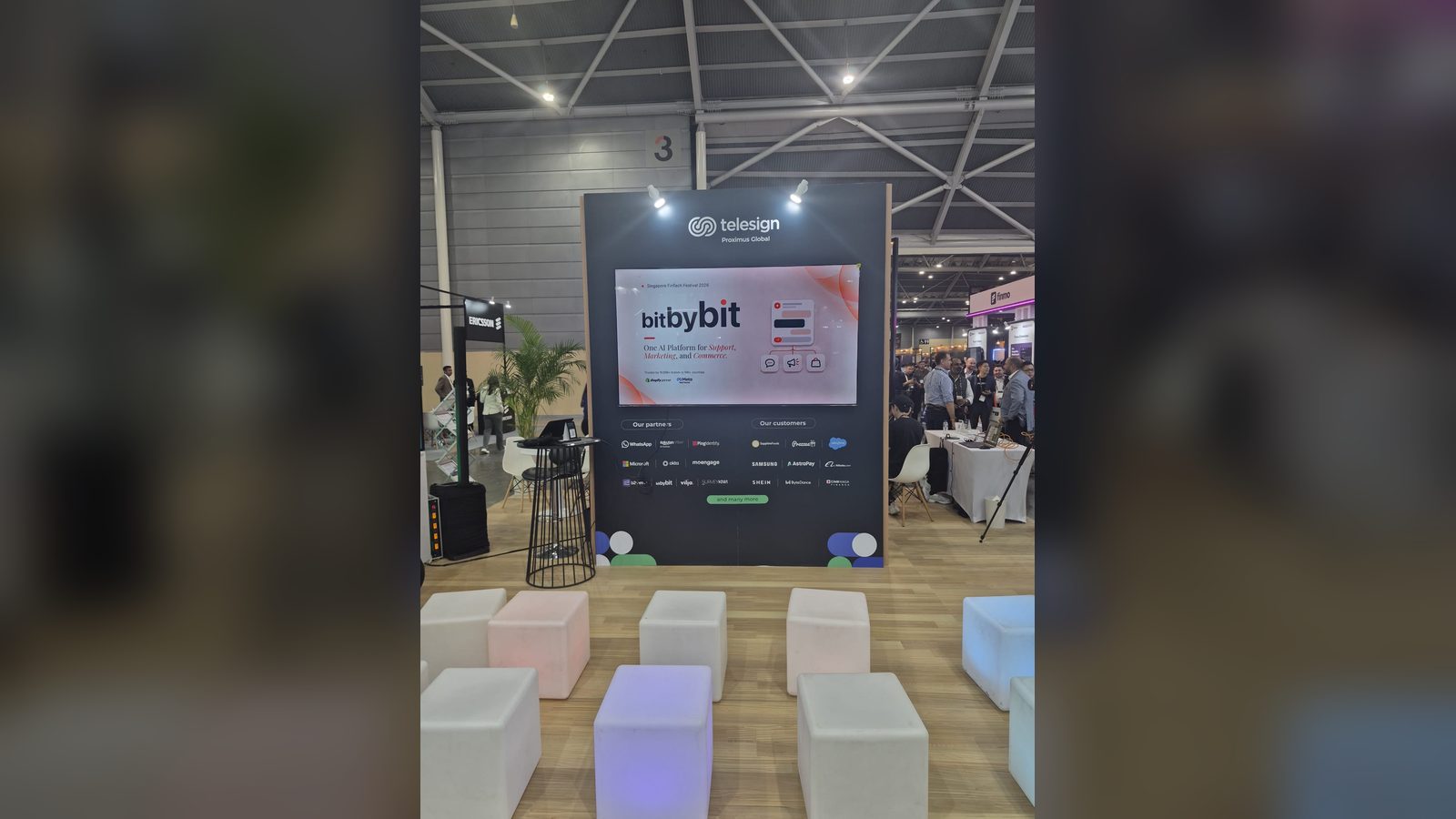
What Singapore FinTech Festival 2026 showed brands.
At Singapore FinTech Festival 2026 (SFF 2026), two of the largest payment networks showed AI agents completing purchases, a sign that agentic commerce is moving from concept to demo. Mastercard ran a demo in which an agent bought a coffee from an instruction the consumer had recorded earlier. Visa showed agent-to-agent interactions and simulated shopping from product search to payment.
The same week’s data points to the constraint. Consumers use generative AI heavily, but only a minority say they would trust it to buy everyday items for them. For brands, that makes the next 24 months a question of trust in AI before it is a technology problem. This article looks at what the evidence says, what it does not say, and where conversational commerce fits.
TL;DR: The payment industry has shown that AI agents can pay. Shoppers have not agreed to let them.
What is agentic commerce?
TL;DR: Agentic commerce is shopping where an AI agent researches, compares and sometimes buys on the customer’s behalf.
In agentic commerce, software agents act for a consumer or a business: they search across stores, compare options and can complete the purchase, with varying amounts of human approval. Banks, payment networks and merchants are all building for it. The open question is how much autonomy customers will actually hand over.
- Step 1ResearchThe agent searches across stores.
- Step 2CompareThe agent weighs the options for the customer.
- Step 3Where trust is testedBuyThe agent completes the purchase, with more or less human approval.
1. Do consumers trust AI shopping agents? Not yet
TL;DR: The industry’s own executives and research say trust, not technology, is the bottleneck.
Mastercard’s Asia Pacific payments executive said at the festival that AI can already complete payments and that the harder challenge is building the trust needed for adoption (Fortune Indonesia).
Visa’s research points the same way. In a survey of consumers in Singapore, Australia and Japan, generative AI use ranged from 67% in Japan to 90% in Singapore, while only 20% to 30% said they would trust AI to buy regularly purchased household items (Visa, via PR Newswire syndication).
Two cautions: the survey was run by a company that wants agentic commerce to succeed, and it covers three markets, not the world. Treat it as a direction, not a forecast.
Other 2025 research points the same way
Worldpay, working with research firm The Lantern, reported that only 5% of consumers globally had no concerns about agentic commerce (Worldpay, 2025).
Checkout.com’s own research found 42% of consumers fear losing control over what gets purchased and 28% cite a lack of transparency (Checkout.com, 2025).
Both are vendor studies from 2025, so they are context, not proof.
2. Agentic payments infrastructure is converging, but not settled
TL;DR: Networks are signing up partners, yet there is still no common standard for agent identity.
- Visa Agentic ReadyVisa says the program now works with more than 50 acquirers, payment service providers, gateways and selected merchants to prepare for agent-initiated transactions.
- The payments provider, which also exhibited at SFF, supports Visa, UnionPay and Mastercard agent protocols through adapters because no common standard exists yet.
- Described two routes, protocol standardization and payment enablement across many rails, and expected them to converge.
Lianlian also expects people to accept agents making small payments well before large ones, and says human confirmation is still expected for larger transactions (FinTech Futures). Its account suggests the common standard Forrester expected a year earlier is still missing.
3. Merchants expect agent-driven volume
TL;DR: Merchants are planning for agents to initiate a meaningful share of transactions soon, which raises the stakes on trust.
FinTech Futures cites an S&P Global merchant study finding that more than two-thirds of merchants expect AI agents to initiate at least 10% of their e-commerce transactions within three years, and that 65% are considering adding a payment partner for agentic commerce (FinTech Futures, citing S&P Global). The same article reports that Alipay recorded over 300 million agent-initiated transactions through its AI Pay product earlier in 2026, a figure we have not verified independently.
Expectations are not outcomes, and surveys of merchants tend to run ahead of shoppers. But the direction matters. If merchants prepare for agent-initiated orders and consumers do not trust them, the gap lands on the brand: disputes, refunds and lost customers.
4. The layer the payment announcements skip: the conversation
TL;DR: Payment protocols prove that an agent was authorised. They do not show that the customer actually asked for this order, or why.
This is our analysis, not a finding from the sources. Almost everything shown at SFF concerns the payment step: identity of the agent, spending limits, proof of authorisation. Those are necessary. They answer one question: was this agent allowed to pay?
They do not answer the questions a brand faces when something goes wrong.
- Did the customer really want this?
- Did they see the price?
- What did they say before the order?
That context lives in the conversation between the customer and the brand. For brands selling through WhatsApp Commerce, the thread is the closest thing to a record of intent.
Worldpay’s research hints that familiarity matters. In its US results, consumers gave retailer-provided agents an average trust score of 3.76 out of 5, against 3.22 for phone assistants like Siri and 2.42 for personal AI agents like ChatGPT. China was the exception, with personal AI agents scoring higher than retailers (Worldpay). It is one market and one 2025 study from a vendor, but it supports the idea that an agent run by a brand the customer already knows starts with a trust advantage.
Even the protocol designers appear to recognise the stakes of who holds the customer relationship. Forrester’s SFF 2025 summary notes that the Agentic Commerce Protocol from Stripe and OpenAI is designed to keep the merchant in control of orders, payments and the customer relationship.
A conversation-first scenario
TL;DR: A reorder flow shows how a chat thread can carry consent that a payment token cannot.
This scenario is hypothetical and contains no data. A customer of a Shopify skincare brand messages on WhatsApp. A WhatsApp AI agent finds the previous order, replies with the items, the price and the delivery address, and asks for a one-tap confirmation.
The order is created, and the thread, including the confirmation, sits in the customer’s record. Compare that with an agent that buys on its own from a standing instruction. Payment-wise, both orders can be equally secure. But in the first case the brand holds a clear, customer-written record of what was requested and approved. If the customer later disputes the order, there is something concrete to look at.
Actionable recommendations
TL;DR: Start small, make confirmation cheap, store consent as data, and measure trust directly.
These are bitbybit Studio’s recommendations, based on the evidence above.
- 1. Start with low-risk, repeat purchasesReorders and replenishment are the closest analogue to the small, frequent payments that sources expect to come first. Avoid high-value or one-off purchases until you have trust data.
- 2. Make confirmation cheap and explicitA one-tap confirmation in the thread costs the customer almost nothing and gives you a clear approval. Keep a human available for high-value orders and exceptions.
- 3. Store consent as customer dataRecord what was asked, what the agent proposed and what the customer confirmed, in your CRM (for example [bitCRM](/bitcrm/)), so each agent action traces to a customer message.
- 4. Keep the relationship on a channel you ownIf agents increasingly mediate purchases, the brand that holds the conversation holds the context and the history.
Track these four rates for agent-led orders, and set your own thresholds before you scale: confirmation rate, correction rate, human-handoff rate, and refund or dispute rate.
Conclusion
TL;DR: The payment layer is being built by others. The conversation layer is where brands can act today.
SFF 2026 showed that AI agents can complete payments. It also showed, in the industry’s own words and data, that shoppers are not yet convinced. The brands that treat trust as a design problem, with clear confirmation, records of consent and a channel they own, will be better placed than those that wait for a payment protocol to solve it for them.
Many brands are now building agent-led conversations on WhatsApp before they build agent-led payments, because the conversation is where trust is earned and recorded. If you are weighing that sequence for your own store, we are glad to compare notes. We covered the festival itself in our Singapore FinTech Festival 2026 recap.
FAQ
TL;DR: Five short answers on agentic commerce, AI shopping agents, trust and WhatsApp.
What is agentic commerce?
Shopping in which AI agents research, compare and sometimes complete purchases for a consumer or business, with different levels of human approval.
What is an AI shopping agent, and how is it different from an AI shopping assistant?
An AI shopping assistant typically recommends products and answers questions. An AI shopping agent can also act, such as placing an order, ideally with the customer’s approval. The line between the two is blurring as products add more actions.
Do consumers trust AI agents to shop for them?
Not yet, on the evidence available. In a Visa survey across Singapore, Australia and Japan, only 20% to 30% said they would trust AI to buy regularly purchased household items, and a 2025 Worldpay study found only 5% of consumers globally had no concerns (per Visa and Worldpay, 2025 research).
How does WhatsApp fit into agentic commerce?
WhatsApp is a channel where customers already message brands, so a WhatsApp AI agent is a natural way to run agent-led conversations that need a clear customer confirmation. In January 2026, Yotpo reported secondhand that Meta told investors it plans to roll out AI shopping agents across Instagram, Facebook and WhatsApp this year (Yotpo).
What should brands do first?
Start with low-risk repeat purchases, make confirmation one tap, store consent as customer data and measure trust directly. The recommendations above set this out in detail.
Sources
- Fortune Indonesia, 19 November 2026
- Visa at Singapore FinTech Festival 2026 (PR Newswire syndication)
- FinTech Futures: SFF 2026, AI agents enter the cross-border payments market
- Forrester: Key takeaways from the Singapore FinTech Festival’s 10th anniversary
- Worldpay: who do consumers trust with their data?
- Checkout.com: how to build consumer trust in AI agents
- Yotpo: Meta is entering agentic commerce
- SFF 2026 dates and venue (MAS)
Disclosure: bitbybit Studio attended Singapore FinTech Festival 2026 alongside Telesign.